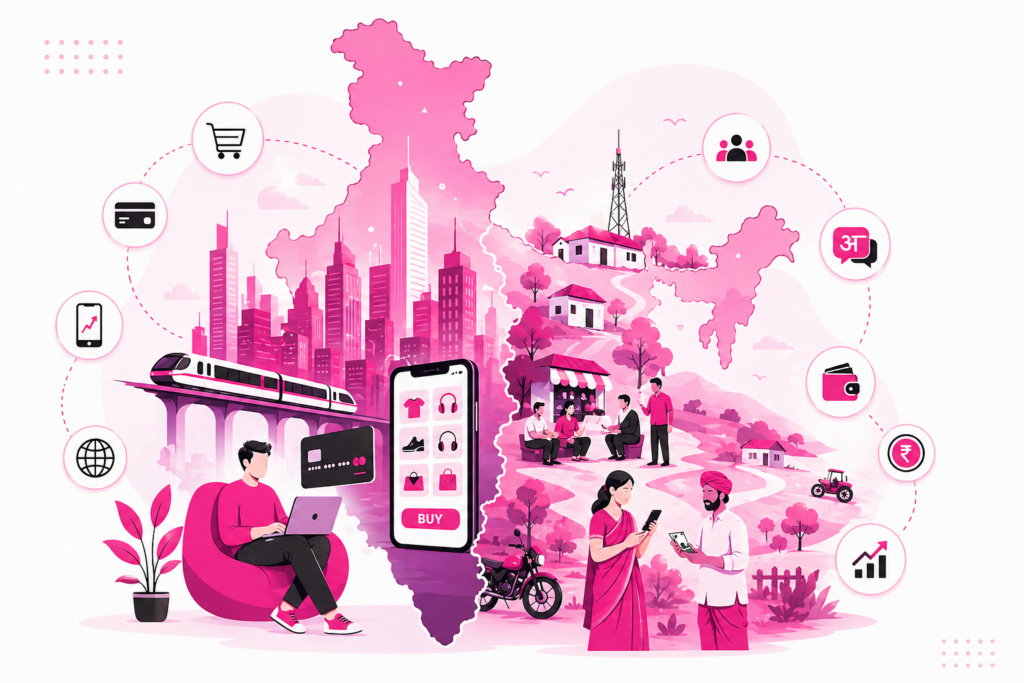
India is not one market. It hasn’t been for a long time. But in 2026, the divide is sharper, more commercially significant, and far less forgiving than most UAE brands realise.
On one side is “India” — metro, English-speaking, digitally saturated, brand-aware.
On the other is “Bharat” — vernacular-first, value-conscious, trust-driven, and spread across tier 2, tier 3, and rural regions.
Both are large. Both are growing. But they behave so differently that treating them as one unified audience is one of the fastest ways to waste marketing spend.
This is not a localisation problem. It’s a market selection decision.

At a macro level, India’s growth story looks unified. But at a consumer level, it splits cleanly into two distinct systems:
These are not segments within one funnel. They are different funnels altogether.
Most UAE consumer brands enter India through metros — Mumbai, Delhi, Bangalore — and build strategy from there. That’s logical, but incomplete.
The problem starts when this metro learning is scaled nationally.
What works in urban India often fails silently in Bharat:
The result isn’t always visible failure. It’s worse: low efficiency, high spend, and weak brand memory.
The next wave of consumption growth is not metro expansion — it’s non-metro acceleration.
Tier 2 and tier 3 cities are:
But here’s the nuance:
These consumers are not “aspiring metros.” They are forming independent consumption identities.
A tier 3 consumer in Tamil Nadu or Uttar Pradesh is not trying to behave like a metro consumer — they are building their own version of value, trust, and aspiration.
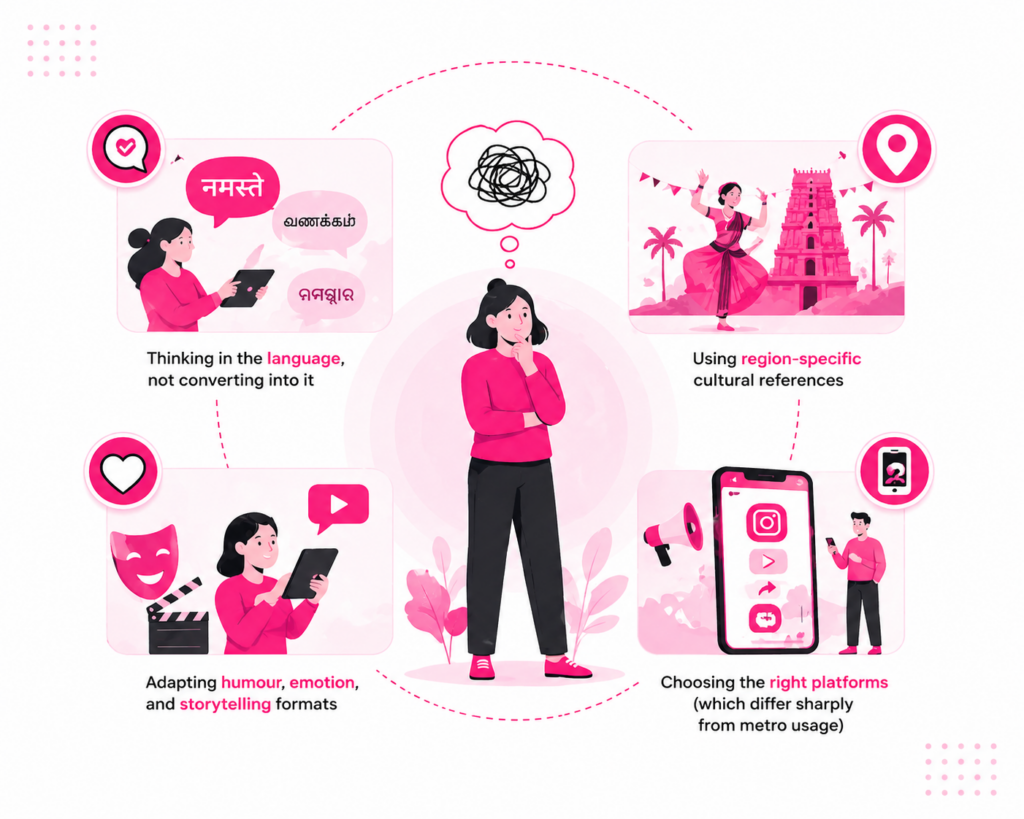
One of the biggest misconceptions UAE brands carry is equating vernacular marketing with translation.
It’s not.
Effective vernacular marketing in India means:
For example:
When brands translate, they communicate.
When they localise deeply, they connect.
“Rural” is often treated as synonymous with “low income” or “low awareness.” That assumption is outdated.
The rural India consumer today is:
What they reject is not brands — it’s irrelevance.
A campaign that performs well in Mumbai may not even register in rural Maharashtra, not because of access issues, but because of context mismatch.
UAE-based FMCG, media, and consumer brands often enter India with strengths:
But India’s Bharat vs India divide introduces challenges that these strengths alone can’t solve:
Uniform media planning
Platform usage varies drastically beyond metros.
The brands winning across both Bharat and India are not choosing one over the other blindly — they are choosing with clarity, backed by research.
A robust approach includes:
Understanding behavioural clusters:
Not surveys translated into local languages, but:
Testing:
Separate:
Because Bharat markets evolve fast — and often unpredictably.
For UAE brands navigating the Bharat vs India market, the real challenge isn’t execution — it’s understanding.
This is where Studio Forge becomes critical.
Studio Forge enables:
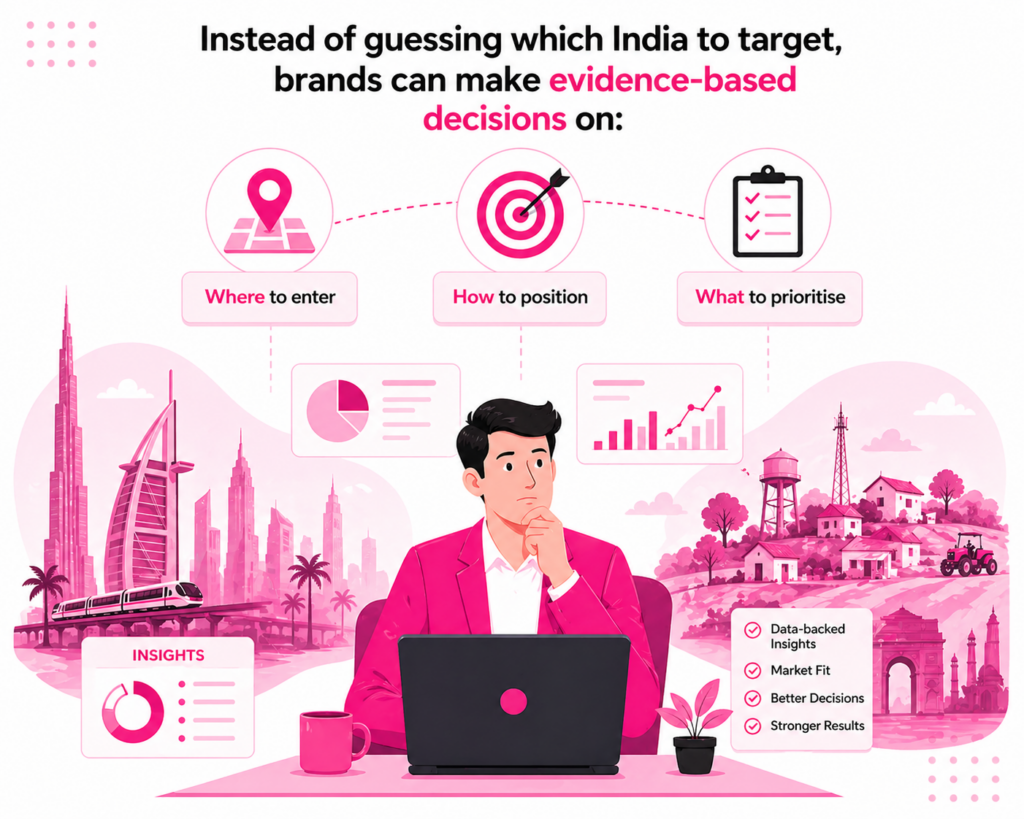
Instead of guessing which India to target, brands can make evidence-based decisions on:
Every brand entering India faces a choice:
What doesn’t work anymore is pretending the distinction doesn’t exist.
Because in 2026, the gap between Bharat and India isn’t narrowing — it’s becoming more defined
India is not one opportunity. It’s two.
And the brands that win are not the ones that try to average them out —
but the ones that choose, understand, and build for each with intent.
In a market this complex, the cost of wrong targeting isn’t just inefficiency — it’s invisibility.
Metro, English-speaking consumers vs vernacular, tier 2/3 and rural consumers with different behaviours.
They scale metro strategies into non-metro markets where consumer realities are completely different.
No, it’s about cultural relevance, not language conversion.
It depends on pricing, category, and growth goals — not a one-size-fits-all choice.