Follow us

How Nike Uses Emotional Marketing to Build a Global Brand

Maheshwari P April 23, 2026

In today’s hyper-competitive global marketplace, having a great product is no longer enough. Brands are not built on features—they are built on feelings.

Among all global companies, Nike stands as one of the most powerful examples of emotional marketing done right. What started as a sportswear company has evolved into a global symbol of ambition, resilience, and self-belief.

Nike doesn’t just sell shoes. It sells courage,It sells identity,It sells the mindset of never giving up.


This blog explores how Nike leverages emotional marketing to dominate globally—and what businesses can learn from its strategy.

At Studio Forge, this approach is seen as the foundation of modern branding-where connection matters more than just conversion.

Table of Contents

Understanding Emotional Marketing

Emotional marketing is a strategy that focuses on connecting with customers’ feelings, desires, and personal identity — rather than just listing product specifications or features. It taps into the human psychology of decision-making, where feelings almost always override facts.

Most brands communicate rationally: “This shoe is durable, lightweight, and lasts 3 years.” Nike communicates emotionally: “Wear this — and become unstoppable.”


That single shift transforms a product purchase into a personal declaration. The customer isn’t just buying footwear; they’re investing in a version of themselves they aspire to be. That is the essence of emotional marketing — and no brand has mastered it more completely than Nike.

Why Emotion Matters in Branding

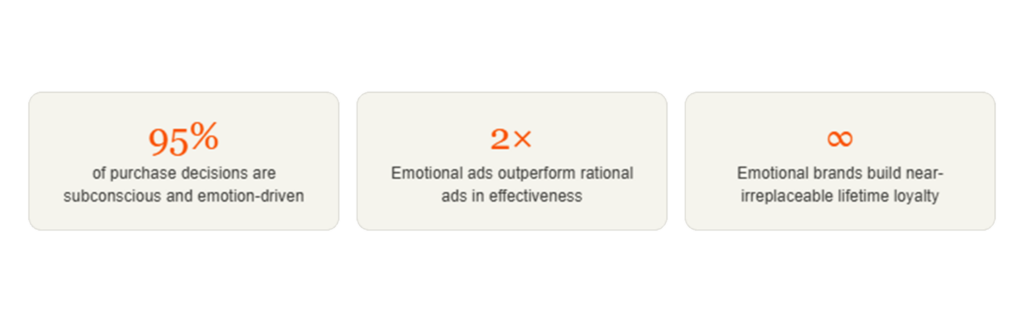
Science and consumer psychology consistently show that emotional connections are far more powerful drivers of brand loyalty than rational arguments. Consider these numbers:

Why does emotion win? Because emotion creates memory. People may forget a product’s specs within days, but they remember how a brand made them feel for years. The brands that win long-term are those that create a feeling – not just a function.


“People may forget what you sell, but they never forget how you make them feel.”

Nike understood this before most brands did. Every campaign, every athlete partnership, every campaign slogan is engineered to trigger a feeling -and that feeling becomes inseparable from the Nike name.

Nike’s Core Emotional Strategy

At the heart of everything Nike does is one radical, democratising idea:

“Anyone can be an athlete.” This isn’t just a marketing slogan – it is a philosophical foundation. It means Nike doesn’t speak only to elite Olympic sprinters or NBA stars. It speaks to the 45-year-old who just started jogging. The teenager who plays basketball in a driveway. The woman who does yoga at 6am before her kids wake up. Everyone is the target audience, because everyone has athletic potential inside them. This is reinforced through their iconic four-word slogan: 
“Just Do It” –  arguably the most powerful brand tagline ever created. It doesn’t describe a product. It gives permission to act, to try, to overcome.

Their strategy focuses on:

Key Campaigns That Built the Brand

“Just Do It” Campaign


Launched in 1988 with a 80-year-old runner named Walt Stack jogging across the Golden Gate Bridge, “Just Do It” was never about elite performance. It was about the universal human impulse to push past comfort and act despite fear or doubt.

The campaign worked because it was radically inclusive — it didn’t show only champions. It showed ordinary people doing extraordinary things on their own terms. Over decades, the tagline became synonymous with self-belief, discipline, and courage across every culture, language, and sport.

Today, “Just Do It” doesn’t just belong to Nike – it belongs to the global cultural lexicon. That is the power of emotional branding done right.


Colin Kaepernick Campaign


In 2018, Nike made a decision that shocked the marketing world: they made Colin Kaepernick – the NFL quarterback who knelt during the national anthem to protest racial injustice – the face of their 30th anniversary “Just Do It” campaign.

The tagline read: “Believe in something. Even if it means sacrificing everything.” This was not a safe, risk-managed ad. Nike took a deliberate stance on one of the most polarising social issues in America at the time.

Predictably, some customers burned Nike shoes. But sales rose 31% in the week following the ad’s release. Why? Because Nike’s core demographic  younger, progressive, urban consumers – felt seen, validated, and deeply emotionally connected to the brand in a new way. Nike didn’t just sell a product. It stood for something bigger than itself.


Dream Crazy Campaign


Narrated by LeBron James, “Dream Crazy” featured real stories of athletes who overcame enormous odds — including a blind wrestler, a double-amputee footballer, and Serena Williams who returned to Grand Slam competition after nearly dying during childbirth.

The campaign was a masterclass in emotional storytelling. Every story arc followed the same universal structure: struggle → resilience → triumph. Nike didn’t manufacture these stories – they found real ones and amplified them. The result was content that felt deeply human and authentic, not corporate and polished.

The campaign also championed inclusivity and diversity long before these became marketing buzzwords. By featuring athletes of different abilities, genders, races, and backgrounds, Nike signalled that the athlete’s journey is not reserved for the privileged or the perfect.

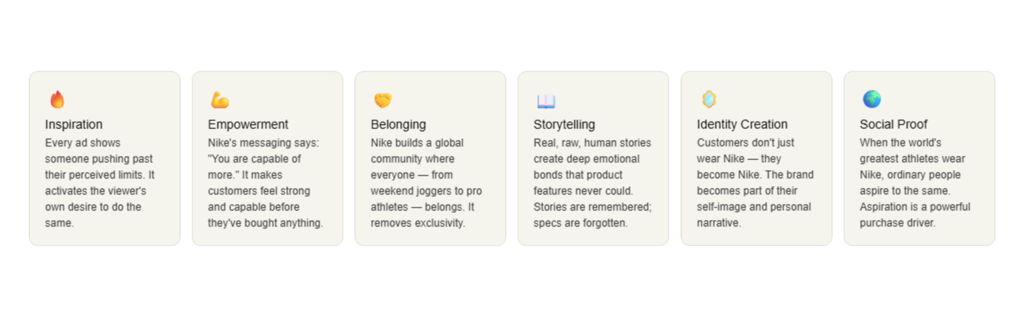
Psychological Triggers Nike Uses

Nike’s success is not accidental — it is the result of carefully deploying psychological triggers that tap into deep human needs and desires.


Lessons for Marketers

Nike’s playbook is not locked behind a billion-dollar budget. The principles are universal and applicable to brands of any size:

Key Takeaways

Conclusion

People don’t buy products. They buy emotions, identity, and belief.


In a world drowning in options, where every category has dozens of competing brands with similar quality and price points, the differentiator is never the product – it’s the feeling the brand creates.

Nike understood this from the beginning. They didn’t build a global empire by engineering better rubber or superior foam cushioning. They built it by understanding human psychology – the desire to feel strong, to belong, to be part of something greater than yourself, and to believe that you are capable of more than you’ve done so far.


The swoosh isn’t just a logo. It’s a promise: that whoever wears it has chosen to pursue their potential. That’s not a product message. That’s a belief system. And belief systems are the most powerful things you can sell.

For any business – regardless of size, category, or budget – the lesson is the same: connect with your customer’s identity, not just their wallet. Build a brand that makes people feel something. The rest will follow.

As emphasized by Studio Forge, the future of branding lies in creating emotional value rather than just pushing products.

What makes "Just Do It" so powerful?

It’s universal. It doesn’t describe a product — it gives everyone permission to act, regardless of skill or fitness level. Three words that replace self-doubt with momentum.

Nike chose their audience over everyone. Sales rose 31% because their core customers , younger, progressive buyers, felt deeply seen. Taking a stance built loyalty, not just awareness.

Yes. You don’t need a big budget – just a clear “why.” Tell real customer stories, stand for something specific, and make your customer the hero. The principles scale to any size.

No. Emotional marketing connects genuinely – the product delivers on its promise. Manipulation exploits fear or insecurity for a sale. Nike earns trust over decades; manipulation destroys it fast.