Coimbatore. Madurai. Trichy. Mysuru. Mangaluru. Vijayawada. Warangal. Kozhikode. These aren’t secondary markets anymore. They’re where South India’s next decade of consumer growth is being built — city by city, rupee by rupee.
The metro-first playbook has served its purpose. The real white space in South India right now isn’t in the cities everyone already knows. It’s in the cities most national brands are still treating as an afterthought — where rising disposable income, rapid digital infrastructure, and a new generation of aspirational consumers have already outpaced the brand options available to them. That gap is the opportunity. But entering without micro-level consumer validation isn’t bold strategy. It’s expensive guesswork.
The numbers have crossed the threshold where they can no longer be ignored.
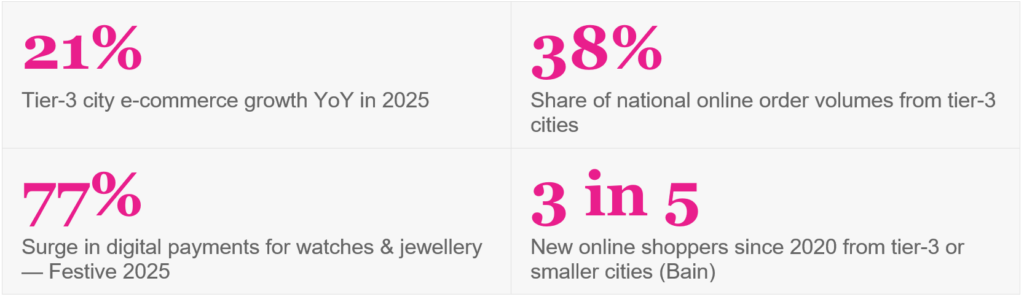
Tier-3 cities across India posted 21% year-on-year e-commerce growth in 2025, contributing 38% of all online order volumes nationally. Three in five new online shoppers since 2020 have come from tier-3 or smaller cities — and their average e-retail spending is now broadly at par with metro consumers. During the 2025 festive season, tier-3 cities recorded a 77% surge in digital payments for watches and jewellery, a 59% rise in grocery spending, and a 51% overall increase in digital payment value year-on-year.
These are not emerging market signals. These are mature consumer market signals from cities that most national brand strategies haven’t yet caught up with. The smartphone penetration, digital payment infrastructure, and e-commerce last-mile logistics that once made tier-2 South India difficult to reach have all hit viable scale in the last 24 months. The consumer is ready. The infrastructure is ready. The question is whether your brand is ready.
"The infrastructure gap between tier-1 and tier-2 South India is closing faster than most brand planning cycles have recognised. The consumer didn't wait for permission to upgrade their aspirations."
Not all tier-2 markets are the same. Each of these eight cities has a distinct economic character, consumer profile, and growth trajectory. Treating them as interchangeable is the first mistake most brands make.
The default assumption when entering tier-2 markets is simple: consumers here are more price-sensitive, so lead with value. This assumption is wrong — or at minimum, dangerously incomplete.
Price sensitivity in tier-2 South India is not uniform. It is category-specific, occasion-specific, and deeply shaped by social context. The same consumer who spends without hesitation on a wedding purchase, a child’s education product, or a health-related item will apply intense scrutiny to an everyday FMCG purchase. The mistake is assuming that scrutiny in some categories defines the consumer across all categories.
The research implication: price sensitivity analysis in tier-2 South India must be conducted at category and occasion level, not as a blanket consumer characterisation. Brands that invest in this nuance consistently find their addressable premium market is significantly larger than pan-India assumptions suggested.
Tier-2 South Indian consumers are not cheap — they are intelligent. They want to know exactly what they are getting for what they are paying, and they are less forgiving of brands that obscure that relationship."
Brand preference in tier-2 South India is not distributed the way national brands assume. Regional and local brands — often invisible in national market share data — hold dominant positions in many categories, built on decades of community trust, hyper-local distribution, and deeply personal brand relationships.
Vernacular-first campaigns consistently outperform translated campaigns by significant margins on brand recall, purchase intent, and emotional connection scores. The investment in genuine vernacular development is not a cost of localisation. It is a multiplier on every other marketing rupee spent.
"A brand that translates its campaign into Tamil hasn't spoken Tamil — it's spoken translated Hindi. Tier-2 consumers hear the difference before they've finished the first sentence."
If there is one finding that emerges with consistent clarity from research across tier-2 South Indian markets, it is this: vernacular-first communication is not a localisation nice-to-have. It is the primary determinant of whether your brand feels relevant or foreign.
This is not simply about translation. A brand that takes its Hindi or English campaign and renders it in Tamil or Telugu has not created vernacular communication. It has created translated communication — and tier-2 consumers, whose primary language is their mother tongue and whose media consumption is predominantly regional, perceive the difference immediately.
The influencer landscape in tier-2 South India operates on fundamentally different principles from the macro-influencer economy that dominates national brand strategies. Understanding how trust is transmitted through local influence networks is one of the highest-leverage moves a brand can make in these markets.
In cities like Trichy, Warangal, and Kozhikode, a regional YouTuber with 80,000 subscribers who reviews products in the local language and dialect carries more purchase influence than a national celebrity with ten million followers. The local creator is perceived as one of us — someone whose context and lived experience mirrors the consumer’s own.
The most influential person in a tier-2 consumer’s purchase decision is often not a public figure at all. It’s the admin of a local housing society WhatsApp group, the most active voice in a professional community, the person whose product recommendations circulate in family networks. These individuals are identifiable through community research and often willing to engage authentically with brands they genuinely believe in.
In markets like Coimbatore, Mangaluru, and Vijayawada, the local retailer, neighbourhood pharmacist, and regional distributor carry community trust that translates directly into brand credibility. Research consistently shows that a brand’s standing with local trade is a significant predictor of consumer preference.
The metric that matters in tier-2 South India is not follower count — it is community depth. How central is this person to a trusted local network, and how much does their recommendation carry within it? A brand strategy built on local influence needs to be built on community mapping research, not platform analytics.

"The most influential person in a Kozhikode consumer's purchase decision might have 12,000 YouTube subscribers and no brand partnerships. But in their community, their word is the closest thing to a guarantee."
Micro-level consumer validation is the research discipline that separates brands that enter tier-2 South India confidently from those that enter expensively. It is not a scaled-down version of national research. It is a fundamentally different approach designed to generate city-level intelligence that blanket studies cannot provide.
"Micro-level consumer validation isn't research overhead — it's the intelligence that tells you whether you're about to spend ₹5 crore on a campaign that resonates or one that lands in silence."