South India — Tamil Nadu, Kerala, Karnataka, Andhra Pradesh, Telangana — is no longer just a regional market. It’s a high-growth economic zone with distinct consumer behaviour patterns. What works in North India doesn’t always work here. And that’s exactly where market research becomes powerful.
South India is staging one of the most significant consumer market transformations in the country. Brands winning here aren’t copy-pasting their north Indian playbooks — they’re winning because they chose to understand this market on its own terms, through research, data, and genuine cultural curiosity. This piece breaks down what’s really happening in the South Indian market, why standard assumptions break down here, and how market research becomes the single most important investment a brand can make in this region.
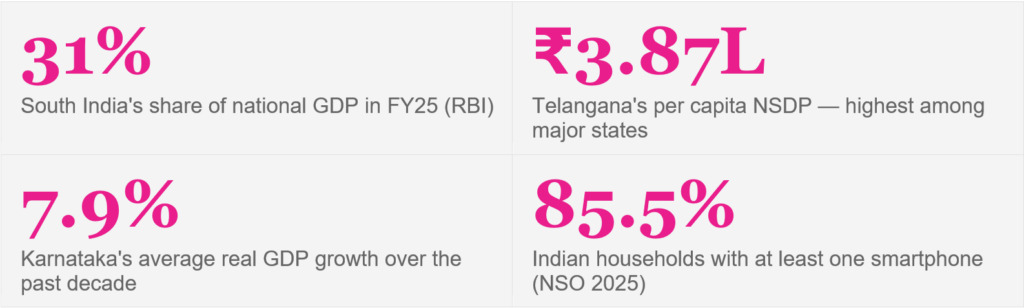
The five southern states contribute approximately 31% of national GDP in FY25 — ahead of the North at 30% — despite accounting for just 20% of the population. The per capita income story is even more telling.
All five states rank in India’s top 10 for per capita income. Telangana leads at ₹3.87 lakh, followed by Karnataka at ₹3.80 lakh, Tamil Nadu at ₹3.61 lakh, Kerala at ₹3.08 lakh, and Andhra Pradesh at ₹2.66 lakh. Karnataka recorded the highest decade-long real GDP growth at 7.9%, followed by Telangana at 7.1%. On the digital side, 85.5% of Indian households now own a smartphone, with South India consistently outperforming the national average.
These aren’t abstract figures. They represent real purchase intent, changing media habits, and an increasingly sophisticated consumer who will not respond to a generic pan-India playbook.

"The south Indian consumer is not a variant of the north Indian consumer. They are a fundamentally different audience — with different trust signals, media touchpoints, and purchase drivers."
South India isn’t a geography. It’s a mindset. Here are the specific fault lines that brands consistently misread.
You can hypothesise about your south Indian audience. Or you can know them. The difference shows up in campaign effectiveness, media spend efficiency, and ultimately market share.
The uncomfortable truth: your assumptions about this market — built from north Indian data, urban focus groups, or national surveys — are probably incomplete. South India’s consumer landscape is actively resistant to generalisation. What’s true in Chennai may be false in Kochi. What resonates in Bengaluru may mean nothing in Madurai.
"In a market where consumer identity runs this deep, the cost of a wrong assumption isn't just a failed campaign — it's a brand perception wound that takes years to recover from."
Brands winning in South India in 2026 aren’t spending more. They’re spending smarter — because their decisions are built on insight, not instinct. A properly constructed research-led strategy operates on five pillars.
South India is in a rare moment. Categories are expanding. Digital infrastructure has reached the scale required for commerce, media, and community to converge. A generation with rising incomes and high aspirations is actively forming brand preferences — and those preferences, once formed in high-trust markets like this, tend to stick.
The brands that understand this market now will hold the positions every competitor will want in three to five years. The brands that don’t — that deploy national playbooks with regional dubbing and call it localisation — will spend money here without building anything lasting.
Markets at this stage don’t stay wide open. Category leaders are forming. Consumer loyalties are being established. The cost of entering a market already defined by a competitor is always higher than building early, when the category architecture is still fluid.
"In high-growth, high-complexity markets, data isn't overhead — it's the highest-return investment on your marketing budget."
South India is in a rare moment. Categories are expanding. Digital infrastructure has reached the scale required for commerce, media, and community to converge. A generation with rising incomes and high aspirations is actively forming brand preferences — and those preferences, once formed in high-trust markets like this, tend to stick.
The brands that understand this market now will hold the positions every competitor will want in three to five years. The brands that don’t — that deploy national playbooks with regional dubbing and call it localisation — will spend money here without building anything lasting.
Markets at this stage don’t stay wide open. Category leaders are forming. Consumer loyalties are being established. The cost of entering a market already defined by a competitor is always higher than building early, when the category architecture is still fluid.
"In high-growth, high-complexity markets, data isn't overhead — it's the highest-return investment on your marketing budget."
Trust is the currency that matters most in South India. It is earned slowly, protected fiercely, and lost rapidly. Understanding how south Indian consumers extend and withdraw trust from brands is the strategic foundation on which durable market positions are built.
"South Indian brand loyalty isn't transactional. It's relational — earning it is hard, keeping it is vital, and losing it is a much bigger problem than most brands budget for."
Every major brand is already competing in Chennai, Bengaluru, Hyderabad, Kochi, and Coimbatore. The next growth frontier — most underresearched, most underinvested, most transformative — is the tier-2 and tier-3 city belt across all five states.
"The next South India growth story isn't in the metros everyone is already fighting over — it's in the tier-2 belt that's vast, underresearched, and ready for brands that take the time to understand it properly."
South India contributes 31% of national GDP while holding just 20% of the population, with all five states in India’s top 10 for per capita income. Beyond economics, the region has its own language ecosystem, media universe, and consumer trust architecture that behave fundamentally differently from north and central India. Brands treating it as a variant of their national market consistently underperform.
The five most common: translating campaigns instead of adapting them culturally; using pan-India personas for south Indian strategy; underestimating premium readiness; building media plans from national platform assumptions; and treating five distinct states as one homogeneous market.
Yes — and it has been for longer than most brands have acted on. Telangana, Karnataka, and Tamil Nadu hold the top three per capita incomes among major states after Delhi. Kerala has India’s lowest poverty rate at 0.55%. The south Indian consumer is quality-conscious and willing to pay for genuine long-term value.
Tier-3 cities recorded 21% year-on-year e-commerce growth in 2025, contributing 38% of order volumes nationally. Digital payment growth in smaller cities surged 51% during the 2025 festive season. Cities like Madurai, Vijayawada, Thrissur, and Mangaluru are forming brand preferences now, before competitive crowding arrives.
Three levels: foundation research (state-level profiling, white space mapping, psychographic segmentation); campaign research (concept testing and cultural validation before major productions); and quarterly brand health tracking benchmarked against south-specific norms. Together these cost a fraction of total marketing spend but deliver disproportionate impact on efficiency.